Monday, April 03, 2006

Two Men and a Bible

When I went to the History Room, I learned that Granddaddy Moore had two favorite Bible verses. The first was from the Sermon on the Mount:

Seek ye first the kingdom of the Lord and his righteousness
and all these things shall be added unto you.
Matthew 6:33

The second, from my version of the Bible (since I don't have a King James), is

he said to me, "My grace is sufficient for you,
for power is made perfect in weakness."
So, I will boast all the more gladly of my weaknesses,
so that the power of Christ may dwell in me.

II Corinthians 12:9

In his life and in his preaching, Granddaddy put God first.

I learned today that Dad had favorite Bible verses as well. Buried in the trunks were two pieces of paper, neatly written in different colors of marker. The holes in them indicated that they had hung on a wall somewhere. Compared to all the other pencil-covered scraps, these were practically plaques. Here they are:

That's my dad.

Hail hath no fury

Last night after supper I went to my sister's house to unearth two wooden trunks at the back of a storage shed. They're pretty much all we have left of Dad besides our memories, and I had decided that today was the day to brave them. Janet and I moved stuff out of the way to clear a path, and then sat on her back porch and talked, still trying to puzzle out pieces that can never finally make complete sense. The rain was just beginning as I pulled into my own driveway.

Major storms in the night. Crashing thunder, daytime-bright lightning, and even hail. John ended up having to go to another room to sleep, and I found myself with little redheads on either side, snuggling up for mama-comfort. I lay there thinking, "Is that you, Dad? I don't care what you say, I'm going over there anyway. I'm opening up those trunks, and I'm seeing what's inside. I've put it off this long--you can't scare me away." After all, I'm familiar with Dad storming in the night. Yes, there's fear, but I've got my share of bravado, too.

This morning it was all I could do to drag myself out of bed, but I did it. And in the pouring-down rain, I drove back across town to face the trunks.

It was a far cry from my welcome to the History Room at Vineville Baptist Church (Welcome to the History Room), and my visit to the Walter Moore Papers in Special Collections at Mercer University. There, everything was in file folders, neatly labelled, all inventoried and categorized, well lit, with tables for spreading out and a copier nearby. Sanitary. Orderly. Typed. Sane.

Today, for a more realistic experience, I really should have been sorting through papers and books in a dark moldy tent in the woods. But I couldn't have done it. Instead, I spent two hours sitting on the floor of the storage shed with a flashlight, pulling out old books, opening envelopes, deciphering the pencilled notations of a manic tortured soul who wanted desperately to make sense of the world. I could only barely manage, surfacing every few minutes into the light and fresh air to regain my balance and perspective on the world.

What got to me most were the letters I found from my childhood self to her daddy, missing him, loving him, wishing him the best.

Oh, I do hope I have the strength for what lies ahead. Surely it can't be any harder than what I've been through already.

As I pulled out of Janet's driveway this morning, the sun broke through the clouds. I can do this. I can.


Sunday, April 02, 2006

Fire & Water

My dad started out a preacher and ended up an astrologer. There's one thing you can say for him--he stayed focused on the heavens!

He was a scorpio, and though I really know nothing at all about such things, astrology.com just informed me that this is a very intense sign. Duh. Also that each sign has an element associated with it, and scorpio is a water sign. Fascinating, since Dad seemed so full of fire.

But water was his only medication. As I've said, he loved to swim. He also washed dishes--it was the one chore around the house he could be counted on to do, though you really couldn't count on the dishes coming out all that clean. He loved the river when he came to the mountains, and would also lie in the tub for hours. I always wondered why he didn't completely shrivel up. And when he left us, no longer able to hold it together, he moved to the beach. There, he could swim with the dolphins, sleep under a catamaran, and listen to the waves--calmly, steadily coming in, going out, coming in, going out. It must have reassured his racing mind, calmed his frenetic spirit. It was the earth saying the same thing Dad used to say to me, in his lyrical southern voice: "everything's gonna be alright."

When I've had a crazy week and all the details are getting to me, my one-and-only will say, "you need to go walk by a creek." And he's right. The continuous bubbles and splashes, over and under, they calm the nerves, lift the spirit, quench the flames of frustration. I may be a gemini and I may not be crazy, but I've got a touch of my daddy's fire in me, and I do love the water.


Bare Feet


Hallelujah, it's barefoot season in the South! I wore sandals to church this morning and my toes are happy. Free at last, free at last.

That was one of the things we all loved about summers at Camp Celo. Shoes weren't only optional there, they were practically unheard of. You'd know you'd spent a summer at camp when the soles of your feet were as tough as the soles of your boots, and you could walk down the gravel road like nothin'. Tough feet were a badge of courage, and we strode with pride. Now my 9-year-old, Caleb, has Camp Celo fever, and he's got the dusty feet to prove it.

With my forays into the past, I've been thinking about the whole "walk a mile in my shoes" thing. Some of us would rather just take them off and wiggle our toes in the warm sand. But again, it's an image of changing perspective. Sharing perspective. With each other.

I've been asking--who knew how bad it was for us back then? What did they know? Why didn't more people know? Why didn't they get it? But this morning I took my shoes off and asked a different set of questions.

Okay, let's think of a family I'm close friends with. Got it. The parents are friends, the kids are friends, we hang out. Now imagine that the dad in that family has some wacky ideas, loves to talk about esoteric things. A little odd, but he's very charming, clearly well-educated, twinkle in his eye, interesting guy. The mom is a can-do woman. She has a job she loves, supports the family financially, and always seems to see the bright side of everything. She's very interested in what I'm up to, asks great questions, and always keeps the conversation going. Just one of those people that always seems cheerful, no matter what. Such a good friend. Good kids, too. Clean, healthy, smart, plenty of friends--they don't watch TV, so they're always reading books or playing outside or singing songs. Straight A kids.

There's the picture. Do I think the dad is beating up the mom, yelling in the night, controlling what they eat, where they go, who they see? Do I think he's paranoid, mentally ill, usually absent? Do I think I ought to find out more about what's happening, get involved, try to help?

No, frankly, I don't. There aren't any red flags. They seem okay to me. And the truth of the matter is, I don't want to believe that all that could possibly be true. I like these people. I want the best for them. I don't want to imagine that things could be that different, that horribly different, from how they appear.

Yep, I get it. I wouldn't want to see the truth either.

Sometimes, when I put my bare feet on solid ground, things get a little clearer. And when your feet are on solid ground, it's hard to imagine that the ground could be shaky for anybody else.

Saturday, April 01, 2006

Near Misses


I've been thinking a lot lately about the many times our family could see History over the back fence.

Medgar Evers was gunned down on his front porch in Jackson, Mississippi on June 12, 1963. At that time, our family lived in Whitfield, 15 miles away.

That September, our family moved to Birmingham, where, as I've said, Dad was welcomed as minister of his new church on September 15, the same morning the Sixteenth St. Baptist Church was bombed, just 4 miles away. By that time, Dr. King had already written his famous "Letter from the Birmingham Jail," chastising the white ministers of Birmingham for being so unready for real change. Dad moved to Birmingham determined to be different than the rest and to integrate his church. He was different alright, but he couldn't pull it off. The city was polarized, the church was polarized, and so was he.

From there our family moved to Koinonia Farm in Americus, Georgia. I told a story (Sticks & Stones) about our time there, too, when the Sumter County Sherriff wouldn't let his daughter be friends with my sister Janet because we lived at Koinonia. Yesterday I learned that Martin Luther King had his own opportunity to get to know Sherriff Chappell. In An Easy Burden, Andrew Young described King's 1961 stay in the Americus jail:
Conditions in the Americus jail were so bad several demonstrators had to be bailed out because they simply could not withstand the discomfort and constant abuse. The marchers had not been prepared to go to jail and the morning of the march it had been fairly warm, so many of them had been arrested in light jackets, even shirtsleeves. Then a cold wave hit. When Martin asked Sheriff Chappell for blankets for the marchers, the heat was turned off, the few available blankets were removed, the windows were opened, and even the fans were turned on.
MLK described Sheriff Chappell as "the meanest man I have ever met." Probably just as well Janet never spent the night with the sheriff's daughter, her best friend.

From Koinonia our family moved to Atlanta, where Mom hung up on Coretta Scott King. And that, my friends, is a story for a different day.

Thursday, March 30, 2006

Closets


Earlier I wrote about the doors of my childhood closet, and finding new perspectives. I'm not the only one--look at the Narnia kids. All kinds of cool stuff behind the coats.

But closets have other connotations as well. Skeletons, for one thing. And whether to come out or stay in, and who should know about it. I have friends still struggling with this one, in our days of continued injustice.

My whole family was in the closet. We lied, we covered up, we told half-truths. And as I peek out through the doors now, I'm amazed at how many people still don't know what's behind the coats.

All of you, my blogfriends, you know. Some were there for it, some knew us back then and are only just now learning, others of you are just getting to know me, and are hearing the whole thing. But other people out there still have no idea, even after the divorce and all these years. I have to say it aloud, sometimes two or three times, for it to really dawn on people who were kept in the dark.

But it's true. It happened. He used his hands, his fists, his anger, his strength. It wasn't just words, as so many believed. There were bruises, blood, slams against the wall. Choking. One time, he threw an iron skillet. That kitchen floor still bears the scar. I saw some of it, heard it all.

It's time for the secret-keeping to be finished. It just shames all of us.

Tellin' it

My granddaddy, Walter L. Moore, was not a civil rights leader per se. He was a company man. He did the usual company-man things: wore a suit, drove a big car, played golf, all of that. His company just happened to be the Baptist Church, a subsidiary of the Kingdom of the Lord.

Okay, I'm trivializing to make a point--Granddaddy was a man of deep faith and strong leadership, and his faith guided his leadership all the way along. But it's true that he was a man of his generation, and although he spoke out strongly and used his influence to further the cause of civil rights in Georgia, he didn't see himself as being a part of "the movement." Until last year when our family celebrated his 100th birthday, I really didn't even know that he felt the injustice all around him so keenly.

But listen to this piece of a sermon from 1938 in Cedartown, Georgia:

Even until this good day, race prejudice and provincialism have retarded the spread of the good news. We feel that we are the only race worth saving. . . . If an African is worthy to carry our crosses, he is worthy to hear what the cross means. Christ does not recognize the barriers of race. If you can't find it in your heart to have a brotherly feeling for the brother in black, I'm afraid you'll have to sit by him in the next world, because some of them are going down there, too.
Whew! Them's fightin' words!

But I'm struck, too, by the end of this very same sermon:

Is it fanatic and unbalanced to be wholly Christian? Since he made us and made us for that purpose, that life is unbalanced and wholly frustrated which devotes itself to anything else.
Granddaddy had not yet met Al Henry, my father, when he spoke these words. And the young Al Henry himself was a long way from his out-of-balance adulthood. But since we lack a professional diagnosis, "fanatic and unbalanced" is a pretty fair assessment of what he became. "Fanatic and unbalanced" is what he became when he felt the unresistable call to leave all and follow Jesus--leave his wife, his daughters, his responsibilities. To live in a tent in the swamp.

The area between wholly Christian and wholly fanatical can get kind of gray. Granddaddy recognized the difference, but not everybody does. Including my dad.

Sunday, March 26, 2006

Brilliance


Today I watched the birthing of the sun from the ocean. Too bad the word "awesome" has lost its meaning, because I need it now. It was a breath-taking start to my day.

They say you're never supposed to look directly at the sun. But in that moment, how could I help it? And it's true, I brought the sunrise back up the beach with me, seeing it again each time I blinked.

My journey feels a little like that. I've been telling myself for years not to look too closely at what happened long ago--it would just bring it all up again. I should put it away, move on. Enjoy this happy adulthood.

But now I'm looking. I can't help it. And although it does sometimes preoccupy the backsides of my eyelids, it's not destroying me. In fact, there's some freedom in there somewhere, I think.

Being near the ocean just always does bring thoughts of Dad. He found peace at the beach.

Thursday, March 23, 2006

Ballooning

When I left my job, my career, and my identity, the love of my life decided it was time for a balloon ride. So that's what he gave me for my birthday that year--a ride in a hot-air balloon. What a way to celebrate.

I thought it would be exciting, but it was one of the most peaceful things I've ever done. Since you travel the same speed as the wind and the blast of hot air is only occasional, the silence up in a balloon can be profound. That day, the tourists who had also plopped down the big bucks for their time in the sky couldn't make it, so there were just 5 in the basket: the pilot, the two of us, and two guys who had grown up in that same valley--a father and his grown son.

There wasn't much wind that day either, so we didn't go far. Instead, we travelled in time as we brushed the treetops, with the old father telling stories of who used to own that land over there, and how that barn there was the most modern thing going when it was built in 1955. Now that developers have gotten interested in that whole beautiful valley, his family's deep connection to the land will soon be stripped away.

When we landed on the roadside it was church time, but I didn't see how being in church could make me feel any closer to God than brushing the treetops and listening to stories about the soil.

With my father's mental illness, talking to him was like going up with a balloon, but that was a whole different thing. More like holding onto the single string of a helium balloon, holding on for all you were worth.

You'd start with both feet on the ground. He'd be easy and friendly with you, asking about something he knew you were interested in. Depending on the time in my life, it would be Shakespeare, or literacy, or the YWCA, or whatever. He somehow knew enough about where I was to have a good solid starting point. I'd think we were going to talk about me for a change. Or at least places that our interests connected.

But then would come the gradual lift-off, so gentle you wouldn't usually notice until your feet were about 5 feet off the ground. At that point it felt rude to let go, so you'd hang on. It's just a conversation, you'd think--what could be the harm? Then that deep-south drawl would take you up and up, higher and higher, until the ground looked too far away for a safe jump. At that point you held on because you had to. And here you were, up in the ether with him. How did we get from Shakespeare to the ancient rituals of the Chaldeans, and how they could save our world if people would only listen? Then the question would become a little scarier: am I crazy, too, now that I'm up here with him?

And that question, that very question, was the one that haunted me throughout my childhood, adolescence, and beyond:
Am I crazy, too?
It was a fear way beyond any of the others.

Now that I'm almost 40, I think I have the answer. And some peace.


Wednesday, March 22, 2006

Celebration


In the March sunshine at mid-day, four mid-life women shared a picnic. It didn't look a thing like Renoir's party, but it was still great fun. A theme of our conversation was celebration. We all need more of it. It feeds us, keeps us going, gives us strength. Play is a powerful thing. I didn't always get enough celebration in my childhood.

A month after our family moved to Cabbagetown, here came the Christmas holidays. Tinsel, lights, wrapping paper, gaiety. Dad wasn't having any. Mom announced that we were going to her parents' house for Christmas; Dad got on a bus for Chicago. When he came back, it was the beginning of his first deep depression. Days, if not weeks, in a darkened room, with the quilt up to his chin. Mom's next announcement was to us: "well girls, it looks like we're going to have to choose between having Christmas or having a daddy, so we'll have to give up Christmas." I was a year old. We didn't celebrate Christmas again in our home until the divorce, 13 years later.

Birthdays soon went the way of Christmas--Dad decided they were too materialistic, and we weren't going to celebrate them anymore. So the only birthday celebration that I remember from my childhood, at least the only one that we didn't have to sneak away for, was when I turned 6 at Hidden Springs. You saw the picture of my grandmamas there. I'll never forget the cardboard dollhouse that Janet and her friends made for me, with lots of rooms, all painted peacock blue. I thought I'd bust with happiness.

Dad left for the woods right about that time. It was his first disappearance. He was gone for weeks, and we had no idea where he was.

So now, as a result, I have a missionary-like zeal about celebration. I love to be silly in front of crowds, knit silvery scarves, and fling them around my neck. I love to bake birthday cake and give presents. I love to turn the music up loud and dance in the kitchen. And perhaps most of all, I love the lights of Christmas. The simplest Christmas tree of all (like the first one Mom and I had in 1980, when we cut our own tree in the woods and hand-made the God's eyes to decorate it), takes my breath away.

I am alive, and I love to celebrate it.

Tuesday, March 21, 2006

Over Easy

Last week I had some fine quiche. It was light and fluffy, made with eggs fresh from the farm of wise friends. They're old friends of our family--they first met our clan at Koinonia in 1965, and have kept in touch over the years. Never a part of our everyday lives, they've been in and out, and they shared with me their perspectives on our family from a distance.

She told the story of bringing a big ole casserole to help feed the helpers moving our family into Cabbagetown in 1967 (you can check out the Cabbagetown link). Having already met us at Koinonia and knowing that our family had moved from Birmingham before that, she had some concerns on that November day. Why was this father of four moving his family into riskier and riskier situations? To Birmingham at the height of the violence there, to Koinonia in the midst of the boycott, and now, as a civil rights activist, bringing his wife and daughters into a blue-collar white neighborhood. It made her appreciate her own steady husband.

And he talked about the atmosphere of the civil rights era. "It was hard," he said, "and yet there was an exhilaration about it. You were on the edge a lot." Which, of course, is right where Dad was drawn, time and time again. He was a passionate man. He craved that exhilaration.

As my friend mused, it does make you think about the whole question of whether the man makes the history or the history makes the man. Chickens and eggs. And mighty fine quiche.

Sunday, March 19, 2006

Literacy

My first real job set a path for my life, too.

When I finished my master's degree in English at Chapel Hill, I knew I didn't want to be an academic, but I had no clue what I was supposed to be doing. A friend suggested that I volunteer as a tutor at the local literacy council. So I did, and before I knew it I was the executive director. It was a hold-onto-your-hat kind of experience.

I learned so much in that job--about management, nonprofits and how they work, and the field of literacy. (Here's a picture of a highlight day from that job: I got to introduce one of my personal heroes, Lee Smith, when she spoke at a fund-raising event.)

Through my work in literacy I learned the word "participatory," and it spoke to so much of my upbringing: finding the strengths that already exist in a person or community and fanning the embers, rather than bringing flames from the outside. I learned that even in a town like Chapel Hill, where you can hardly spit without dampening a PhD, there are many adults who grew up without the printed word, and are still getting by. It takes real strength and ingenuity to get by like that.

I know because I've done my own share of getting by, slipping through. As I've said, my dad turned against the church in 1965, one year before my birth. So once I came along, we never darkened a church's doors. And that meant that while my older sisters had a fairly decent foundation for their biblical education, I missed out altogether. No Sunday School, no sermons, no bible reading, nothing. Zilch. My mom tried, but I had been well-schooled by Dad in the hypocrisy of organized religion, and I bucked it. So I missed out. While my friends in high school, college, and graduate school were picking up the Christian references like windfall apples, I was blithely watching the butterflies. I faked it, wrote about other things. Slid through.

And now here I am, writing the story of two seminarians who were both deeply influenced by their reading of the scripture. They were steeped in it. And I'm illiterate. Where in heaven do I start?

Saturday, March 18, 2006

Whitfield

My dad's mother was mentally ill, too. I don't have many of the details. A fuzzy story about her standing in front of Rich's department store in downtown Atlanta, handing out money to the passersby, introducing herself as the Virgin Mary and Dad as baby Jesus. A low-voiced remark about shock treatment. Bitter memories from Dad about all the time he spent with his grandparents, while his mom was in the hospital. I've heard she was diagnosed bipolar.

By the time I knew her she just seemed, well, odd. She loved to shop for bargains, and had all kinds of strange things under her bed. Lots of underwear that were unlikely to fit anyone she knew. She made us ice cream floats with Tab (blech, but we drank them politely) and fed us those wafery cookies with the creme centers. I loved her, but never felt the bond that I did with Grandmama Moore. (Here's a picture of me with both my grandmamas on my sixth birthday. Dad's mom is in the foreground.)

Considering all that, it's fascinating to me that Dad's first real job was in a mental hospital. After he left Southern Seminary in Louisville, he got a job as chaplain at the Mississippi State Mental Hospital in Whitfield, 15 miles from the state capital, Jackson. Mom tells the story that when they went for his first interview, they got lost on the way, and stopped to ask for directions to Whitfield. The friendly fellow at the gas station replied, "well, you just start acting crazy, and they'll take you right to it." Dad actually worked there twice, from 1953 to '55, and 1961 to '63 (again, there's a link, if you want to see what it looks like today).

What must that have been like--a state mental hospital, in Mississippi, in the early 50's? And knowing that your own mother experienced this treatment, and maybe even worse, in the decades before? To me, it sounds like the stuff of horror movies. And there he was, providing spiritual sustenance and support to patients and families inside the asylum's brick walls. Trying to give them hope.

I wonder if he had any nightmarish glimpses of his own simmering demons.

Friday, March 17, 2006

Crossed hands, braided hair

Here's a picture of me with my hippie family and some friends in 1975.


You can see why everybody thought we were basically okay.

That was probably the summer that we camped by the creek. Janet and I would retreat into the undergrowth of rhododendron and imagination when the campfire burned too hot. Somehow we still got burned.

Ups & Downs

Huh. From this vantage point, yesterday looks like a pretty bi-polar day, doesn't it?

Fascinating.

Thursday, March 16, 2006

The Lottery

If I won the lottery, I'd build myself a room just for wrapping presents. I love the whole gift-giving business.

I love the planning, making lists, thinking of quirky things about the people I love, and finding the perfect present to fit each quirk. I love walking through a store when something yells, "Buy me! I need to go to [fill in the blank]'s house!" I love buying fun wrapping paper, making the corners crisp, and tying the ribbon around Katie's little index finger. And I love the light in people's eyes when they've gotten a really fun present, something they never would have gotten for themselves.

An unexpected delight of this book process is the presents that have come to me. There are the stories, of course--each one gives me more to think about and adds another facet to my growing story. But then there are other spontaneous gifts: a 50-cent yard sale umbrella big enough for my whole family, a Cabbagetown CD with songs that make me laugh aloud, record albums of Clarence reading his Cotton Patch Gospel. Oh, and the books. Loads of 'em. I just wish I had enough shelf space!

I'm loving the gifts. I guess I am winning the lottery, a little at a time.

Solace

Today is the second anniversary of my daddy's death. I sure did love him.

Yes, he was scary, and violent, and left us for months at a time. Yes, he blamed me for things that weren't my fault, and used his tears to make me feel guilty. Yes, he put himself before us, refusing treatment for his mental illness, when medication may well have made a difference. I was livid for years, and a big part of me still is.

But I still love him. He had a twinkle in his eye, and he told me I was the apple of it. He sang silly songs sometimes, and played the spoons in old-time jam sessions like nobody's business. He loved the old spirituals, too--they still take away my voice when I turn to them in the hymnal and the rest of the congregation begins to sing. Precious lord, take my hand, lead me on, help me stand. He loved to swim, with a beautiful, long, lazy, comfortable stroke. He read my palm and pointed out the "mystic cross," telling me I would accomplish great things one day, change the world. I believed him.

These are the reasons that, in spite of everything, my tears begin to flow before the sun even rises.

Goodbye, my daddy.

Tuesday, March 14, 2006

Blue Roof

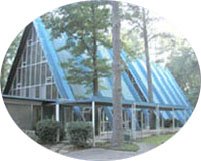
I found the website for Dad's church in Birmingham. I put the link over there on my list.

This is where Dad was getting installed September 15, 1963, two weeks after Janet's 4th birthday, a week and a half before Linda's 11th, and the same Sunday as the bombing at the 16th St. Baptist Church 4 miles away.

Dad left in 1965 because the church refused to integrate, but their website looks pretty inclusive now. Mom says the reason they didn't want to integrate was their new building. They were worried about all the church bombings.

Based on the web address, it looks like their building is still pretty focal. A good reminder about what matters.

Monday, March 13, 2006

My Bag

I was walking through the garage just now, when something fell from a shelf and landed at my feet. My sleeping bag.

When I was 9 years old, my mom made me this down sleeping bag from a kit. That week, there were feathers everywhere.

How I loved that down bag! We camped a lot, since we had no money for any other kind of vacation and Dad's ultimate goal was for us to live in the woods anyway. And I took my bag to two camps, most summers. Way later when I went away to college, I had my sleeping bag on my bed the way some freshmen had stuffed animals. It was my comfort object.

When my sleeping bag was a year old, we moved to Celo, Janet left, and it was Mom, Dad and me. Period. When he was there, anyway. And when they'd fight, there was no big sister to hustle me out the door or crawl in bed with me. Instead, I'd head for the river or the porch, or hover around the edges, waiting for the sign.

Eventually, Mom would mutter to me, "get your sleeping bag," and I knew we were out of there. We'd sleep in the car, or maybe in a friend's attic--waiting for the wrath to dissipate.

Now it's 30 years later, and I have a 9-year-old myself. The downy, delicate feathers inside this thin nylon membrane are still intact. I could still cinch up the string around my nose and be completely protected from the winter winds. If I needed to.

Instead, I put it back on its shelf in the garage. It's good to know it's there. And just as good to know that I really don't need it,
except for camping.

Thursday, March 09, 2006

Sliding Doors


In 1976, Mom had her own epiphany.

She was working as a cook at camp that summer, to help pay my tuition. It was a welcome relief for all of us, getting out of the heat of the Georgia summer.

That day, she had finished serving lunch, and walked through the woods to the little house where she was staying, the Meditation Hut. She lay down for a nap, her usual 5-minute refresher. But that one was different--she woke up with a shining new thought--"we will move to the mountains before the year is out." And we did. December, 1976, our family moved from a suburb of Atlanta to a little community in the middle of the NC mountains. Celo.

We lived in a house up the hill from the river--you had to cross a swinging bridge to get to it. I loved many things about that house: the porch swing, the bridge, the river, the sledding hill, the barns.

And I loved my room. I had my own window seat, looking out at the mountains.

The closets on each side of the window seat had sliding doors, and I loved to pretend they were elevators. I'd shove all the junk to the side (I was not a very organized child), and get in, sliding the door closed behind me. A brief pause--one, two, three, four--the door would slide open, and then, voila! I was in a whole different place! No end of fun.

It feels like the doors are sliding again now. Stories I've heard my whole life have begun to take on new meanings. Memories that used to be funny now seem poignant and powerful.

Interesting what happens when you slide the door closed and let yourself pause in the darkness.