I have a new blog. The link is over there to the left.
My thoughts seem to be drifting more in that direction lately, so I decided to create a space for them.
Friday, August 08, 2008

Sunday, May 25, 2008
Celebrations & Concerns
Today I stood up
in church
and asked everybody
to celebrate my mother.
Forty-two years ago
she was a few days away
from giving birth to me.
She's lived a good life,
and now she feels like she's done.
I asked everybody
to pray
with Mom, for Mom
for all the days she has left.
There are so many,
stretching out ahead.
When I sat down,
she leaned over to me.
"Now that I've lost my brain," she said,
"I can't think."
"But I still have a heart,
and I can still feel.
And I love you."
I love you, too, my Mama.
For nearly forty-two years.
And counting.

in church
and asked everybody
to celebrate my mother.
Forty-two years ago
she was a few days away
from giving birth to me.
She's lived a good life,
and now she feels like she's done.
I asked everybody
to pray
with Mom, for Mom
for all the days she has left.
There are so many,
stretching out ahead.
When I sat down,
she leaned over to me.
"Now that I've lost my brain," she said,
"I can't think."
"But I still have a heart,
and I can still feel.
And I love you."
I love you, too, my Mama.
For nearly forty-two years.
And counting.

Thursday, April 03, 2008
this day
I started this day with three dreams still tumbling around in my head. Fiery attacks, deaths of loved ones, emotional turmoil. My morning pages helped calm the storm.
After the redheads left for their normal destinations, I visited Mom. It didn't take her long to figure out exactly who I was, even though I arrived unannounced. We played Scrabble. My one seven letter word (which earned me 74 points) was RELATED. It felt appropriate. We're still related. We still relate, though differently.
From there I went out into the misty, moisty morning to walk a nearby labyrinth. It always centers my spirit, calms my soul. I breathed in the early spring air, walked carefully on the mossy paths, greeted the rocks as I came to them, again and again. In the center I sat. And listened. To the woods. To myself.
This afternoon I plunged deeply into the 1972 brain of my father. I examined his week-at-a-glance calendar, page by page. There was no glancing about it--at some points I needed a magnifying glass to decode his cryptic astrological notes.
Coming down to the kitchen, where my cheerful beloved was putting the final touches on supper, felt like swimming up from the bottom of a deep, murky pool. 1972 was so real--Dad hitchhiking back and forth, his fasting, his larger-than-life new age ideas. Could it really be that I actually live in 2008, under a roof, with a television and white rice, and a husband who earns a regular paycheck and comes home when we expect him?
Have I really managed to fool the gods and end up with a mainstream, sane, safe, happy life?

Labyrinth indeed.
Gratitude abounds.
After the redheads left for their normal destinations, I visited Mom. It didn't take her long to figure out exactly who I was, even though I arrived unannounced. We played Scrabble. My one seven letter word (which earned me 74 points) was RELATED. It felt appropriate. We're still related. We still relate, though differently.
From there I went out into the misty, moisty morning to walk a nearby labyrinth. It always centers my spirit, calms my soul. I breathed in the early spring air, walked carefully on the mossy paths, greeted the rocks as I came to them, again and again. In the center I sat. And listened. To the woods. To myself.
This afternoon I plunged deeply into the 1972 brain of my father. I examined his week-at-a-glance calendar, page by page. There was no glancing about it--at some points I needed a magnifying glass to decode his cryptic astrological notes.
Coming down to the kitchen, where my cheerful beloved was putting the final touches on supper, felt like swimming up from the bottom of a deep, murky pool. 1972 was so real--Dad hitchhiking back and forth, his fasting, his larger-than-life new age ideas. Could it really be that I actually live in 2008, under a roof, with a television and white rice, and a husband who earns a regular paycheck and comes home when we expect him?
Have I really managed to fool the gods and end up with a mainstream, sane, safe, happy life?

Labyrinth indeed.
Gratitude abounds.
Saturday, March 22, 2008
Thursday, March 06, 2008


Sunday, March 02, 2008
fire next time
Our fireplace burns gas. And yet I split wood.
My 11-year old son got in trouble at church for lighting matches in the Sunday school room when no adults were around. A match was smoldering on the couch, the other kids pointed the finger at him, and he was holding the book of matches when the adult walked in. And yet he claims innocence . . .
During the service we learned that a dear member of our congregation, a white-haired blues-playing saxophone player with twinkling eyes, has been diagnosed with acute leukemia. Another seemingly healthy member of our church faced this same diagnosis a couple of years ago, and lived a matter of days.
And then I spent a couple of hours with my mom--playing Scrabble, walking in a sun-filled field of hummocky almost-springtime grass. This time, for some reason, she didn't mention the fact that she prays every night for God to take her as she sleeps. But it's always in the air around her. I know she's ready to go. Why can't it be her turn instead? She's ready.
Our fireplace burns gas.
And yet I split wood.
It's all I can do.

My 11-year old son got in trouble at church for lighting matches in the Sunday school room when no adults were around. A match was smoldering on the couch, the other kids pointed the finger at him, and he was holding the book of matches when the adult walked in. And yet he claims innocence . . .
During the service we learned that a dear member of our congregation, a white-haired blues-playing saxophone player with twinkling eyes, has been diagnosed with acute leukemia. Another seemingly healthy member of our church faced this same diagnosis a couple of years ago, and lived a matter of days.
And then I spent a couple of hours with my mom--playing Scrabble, walking in a sun-filled field of hummocky almost-springtime grass. This time, for some reason, she didn't mention the fact that she prays every night for God to take her as she sleeps. But it's always in the air around her. I know she's ready to go. Why can't it be her turn instead? She's ready.
Our fireplace burns gas.
And yet I split wood.
It's all I can do.

Thursday, February 14, 2008
Finding Frances
On my quest, thanks to the wonders of the internet, I've been able to find just about everybody I've looked for.
I found Bill, my dad's boss from when he was an ambulance attendant in Atlanta, even though all the other family friends from that time told me that Bill seemed to have fallen off the planet.
I found Neb, Jr., the now 80-year-old man who was the mythical child who called to my mother's sister Sunny from across the street, so that she dashed in front of an oncoming car. The whole family witnessed her death, as did Neb. He still remembers that day, nearly 75 years ago.
I found Pilgrim Congregational Church, with the striking blue roof, where my dad was minister for a year and a half while Birmingham was coming apart, and so was the church. That church was torn down this week, sold to a developer to become a new housing development (see the story here: http://www.al.com/newsflash/regional/index.ssf?/base/news-34/120284634741750.xml&storylist=alabamanews).
Really the only people I haven't been able to find are the ones who have passed on. Those are the true heartbreaks--the people I would love to talk to, ask them to share their stories, hear what they have to laugh about, see the twinkle in their eyes. But they're gone.
One of those is Frances Pauley. She was an amazing woman--a tireless worker for civil rights in Georgia. Spunky, fearless, determined. Julian Bond was quoted as calling her "everybody's grandmother and nobody's fool." She also happened to be my daddy's boss at the Georgia Council on Human Relations in 1967. It's part of the next chapter of my book.
Frances died before I set out on this quest, so I've done what I could to find other ways to get to know her. My cousin gave me a book about her, written by folks at the Open Door Community in Atlanta, where she was active in her later years. I read that. Her papers are housed in special collections at the Emory University library, and I went down to check it out. I got more of a behind-the-scenes sense of her there, and began to form some hunches about what happened when Dad worked with her, which was her last fiery year at the Georgia Council. I recently had breakfast with a friend of mine who knew her, but my friend couldn't remember much.
All of this left me wanting more. If only I could talk to her, ask her my questions, follow up on my hunches, hear her voice! I wanted to get to know her personally, have more connection than the words on a page.
And yesterday it happened.
I was dinking around on the internet, yet again, when I landed on the Southern Oral History Project at UNC, my own alma mater. On a whim I typed "Pauley" in the search place. And what do you think I found?! An interview that Jacquelyn Hall had conducted with Frances Pauley in the Pauleys' living room on July 18, 1974. The transcript and the recorded interview itself! I could download it! I could listen to her voice! As I sat on the floor of my study, headphones on, enrapt, I marvelled that Dr. Hall asked most of the same questions I had been aching to ask Mrs. Pauley myself. I felt like I had time-traveled, and my wish was granted.
One part sticktuitiveness, two parts luck.
Ask and it shall be given unto you.
I found Bill, my dad's boss from when he was an ambulance attendant in Atlanta, even though all the other family friends from that time told me that Bill seemed to have fallen off the planet.
I found Neb, Jr., the now 80-year-old man who was the mythical child who called to my mother's sister Sunny from across the street, so that she dashed in front of an oncoming car. The whole family witnessed her death, as did Neb. He still remembers that day, nearly 75 years ago.
I found Pilgrim Congregational Church, with the striking blue roof, where my dad was minister for a year and a half while Birmingham was coming apart, and so was the church. That church was torn down this week, sold to a developer to become a new housing development (see the story here: http://www.al.com/newsflash/regional/index.ssf?/base/news-34/120284634741750.xml&storylist=alabamanews).
Really the only people I haven't been able to find are the ones who have passed on. Those are the true heartbreaks--the people I would love to talk to, ask them to share their stories, hear what they have to laugh about, see the twinkle in their eyes. But they're gone.
One of those is Frances Pauley. She was an amazing woman--a tireless worker for civil rights in Georgia. Spunky, fearless, determined. Julian Bond was quoted as calling her "everybody's grandmother and nobody's fool." She also happened to be my daddy's boss at the Georgia Council on Human Relations in 1967. It's part of the next chapter of my book.
Frances died before I set out on this quest, so I've done what I could to find other ways to get to know her. My cousin gave me a book about her, written by folks at the Open Door Community in Atlanta, where she was active in her later years. I read that. Her papers are housed in special collections at the Emory University library, and I went down to check it out. I got more of a behind-the-scenes sense of her there, and began to form some hunches about what happened when Dad worked with her, which was her last fiery year at the Georgia Council. I recently had breakfast with a friend of mine who knew her, but my friend couldn't remember much.
All of this left me wanting more. If only I could talk to her, ask her my questions, follow up on my hunches, hear her voice! I wanted to get to know her personally, have more connection than the words on a page.
And yesterday it happened.
I was dinking around on the internet, yet again, when I landed on the Southern Oral History Project at UNC, my own alma mater. On a whim I typed "Pauley" in the search place. And what do you think I found?! An interview that Jacquelyn Hall had conducted with Frances Pauley in the Pauleys' living room on July 18, 1974. The transcript and the recorded interview itself! I
 could download it! I could listen to her voice! As I sat on the floor of my study, headphones on, enrapt, I marvelled that Dr. Hall asked most of the same questions I had been aching to ask Mrs. Pauley myself. I felt like I had time-traveled, and my wish was granted.
One part sticktuitiveness, two parts luck.
Ask and it shall be given unto you.
If you have some time and want to make a great new friend, follow this link: http://docsouth.unc.edu/sohp/G-0046/menu.html.
Monday, January 14, 2008
Sandwich
Making a sandwich
is a constructive proposition.
Gracefully spreading the condiments,
lovingly placing
the meat,
the cheese,
the fluffy green leaves of lettuce.
Finally the two sides meet.
An arranged carbo marriage.
My mother,
who no longer makes sandwiches,
still relishes them.
Her favorite
is peanut butter and jelly.
She has its name written
on a small piece of paper
by her bed
in the rest home
so she won't forget.
Again.
My daughter prefers jam
with her peanut butter.
Or pasta, and no sandwich at all.
The "sandwich generation" is a misnomer.
I'm not a symmetrical union
of bread and whatever.
I'm torn in two.
is a constructive proposition.
Gracefully spreading the condiments,
lovingly placing
the meat,
the cheese,
the fluffy green leaves of lettuce.
Finally the two sides meet.
An arranged carbo marriage.
My mother,
who no longer makes sandwiches,
still relishes them.
Her favorite
is peanut butter and jelly.
She has its name written
on a small piece of paper
by her bed
in the rest home
so she won't forget.
Again.
My daughter prefers jam
with her peanut butter.
Or pasta, and no sandwich at all.
The "sandwich generation" is a misnomer.
I'm not a symmetrical union
of bread and whatever.
I'm torn in two.
Leavin'
When I was in elementary school, my sister Janet was a huge John Denver fan. She'd go in her room, shut the door, put him on her little blue record player, and turn it way up.
Janet wished she could be the one flying far, far away.
During my toddler years (the chapter of my book I'm working on now), my dad was the one thinking of leaving. He would talk for hours to his friend Dave about how the Bible says we should "leave all to follow Jesus." Both Matthew and Mark tell the story, when Jesus said to his disciples, "everyone who has left houses or brothers or sisters or father or mother or children or fields, for my name's sake, will receive a hundredfold, and will inherit eternal life." Dad was convinced, as early as my own bubbly toddler years, that this was his calling. Leave it all for Jesus.
When I try to divorce this idea from my emotion--when I banish thoughts of my curly yellow head and chubby baby hands, when I try not to think about how hard Mom was working to hold our family together in those troubling times, when I don't think about all that my sisters endured for the sake of Dad's callings--the irony remains.
This is The Book of Family Values? Have those people who wield the Bible Belt even read this book?
Leave All.
Love All.
Just the difference of a couple of vowels. Jesus was somehow preaching both. But as the one left behind, it sure didn't feel that way.
Jesus' next line, in both Mark and Mathew's versions of the story, was "the first will be last and the last will be first."
So those of us left behind--are we the first or the last?
But either way, though there was no question that I felt abandoned when my daddy finally left for good, in retrospect it is pretty clear that we were better off. Safer. Saner. Happier.
So . . . last-first, first-last, irony or no, I guess it's possible.
Love all.
Leave all.
But I like it better when I can have the loving without the leaving.
I'm leavin' on a jet plane . . .
Janet wished she could be the one flying far, far away.
During my toddler years (the chapter of my book I'm working on now), my dad was the one thinking of leaving. He would talk for hours to his friend Dave about how the Bible says we should "leave all to follow Jesus." Both Matthew and Mark tell the story, when Jesus said to his disciples, "everyone who has left houses or brothers or sisters or father or mother or children or fields, for my name's sake, will receive a hundredfold, and will inherit eternal life." Dad was convinced, as early as my own bubbly toddler years, that this was his calling. Leave it all for Jesus.
When I try to divorce this idea from my emotion--when I banish thoughts of my curly yellow head and chubby baby hands, when I try not to think about how hard Mom was working to hold our family together in those troubling times, when I don't think about all that my sisters endured for the sake of Dad's callings--the irony remains.
This is The Book of Family Values? Have those people who wield the Bible Belt even read this book?
Leave All.
Love All.
Just the difference of a couple of vowels. Jesus was somehow preaching both. But as the one left behind, it sure didn't feel that way.
Jesus' next line, in both Mark and Mathew's versions of the story, was "the first will be last and the last will be first."
So those of us left behind--are we the first or the last?
But either way, though there was no question that I felt abandoned when my daddy finally left for good, in retrospect it is pretty clear that we were better off. Safer. Saner. Happier.
So . . . last-first, first-last, irony or no, I guess it's possible.
Love all.
Leave all.
But I like it better when I can have the loving without the leaving.
Monday, January 07, 2008
Resolution
Happy New Year!
I used to have the same resolution every year: No Resolutions. I didn't like setting myself up to fail. But last year I tried a new tactic. My resolution was:
More rhinestones in 2008.


I used to have the same resolution every year: No Resolutions. I didn't like setting myself up to fail. But last year I tried a new tactic. My resolution was:
More cussing in 2007.
It worked out pretty well. I definitely did better in the first part of the year, rediscovering the days of my youth by letting it fly on a pretty regular basis. My children were agog. By the end of the year, the joy of the four letter word was wearing off, so I sort of fell off the wagon. So this year I have a new one:
More rhinestones in 2008.

I started early, actually, buying myself a lovely rhinestone souvenir while we were in Texas over the holidays. It brightens my world. And I feel confident that my sparkly keychain is only the beginning.
In addition to my resolution, there are changes I'm making in my life. They're not resolutions. They're changes. Course adjustments, perhaps. Like f'rinstance, I've cut back on my paid work time so that I can get back to focusing on my writing. I have a book to finish, so I'm clearing space for it. First I need to make room, I figure, and then maybe I can begin to remember how to be creative, be open, tell the story.
But as I sat quietly today (something I almost never do--this is all part of making space), I remembered about the knowing part of myself. The part of me that already knows what I should be doing, how to open myself to the story, how to get to where I'm heading. That quiet little part deep down in there that never gives advice, but gives an encouraging nod and a twinkle when I'm on the right path. The part of me that just feels right when I land on what I've known all along.
Resolution doesn't just mean deciding, after all. It's not only about our grandiose plans--to lose weight, quit smoking, sparkle more, or whatever. Resolution is also about clarity. We change the resolution on our computer screens when things don't look right. We change the resolution of our digital images to make them less pixellated, clearer. Resolution is about seeing things more clearly.
Maybe my own resolution is simply that "this is it" feeling of heading the direction that I knew was right all along.
Listening for that quiet voice that never speaks, but just nods, and gives a little twinkle.
Like a rhinestone.
In addition to my resolution, there are changes I'm making in my life. They're not resolutions. They're changes. Course adjustments, perhaps. Like f'rinstance, I've cut back on my paid work time so that I can get back to focusing on my writing. I have a book to finish, so I'm clearing space for it. First I need to make room, I figure, and then maybe I can begin to remember how to be creative, be open, tell the story.
But as I sat quietly today (something I almost never do--this is all part of making space), I remembered about the knowing part of myself. The part of me that already knows what I should be doing, how to open myself to the story, how to get to where I'm heading. That quiet little part deep down in there that never gives advice, but gives an encouraging nod and a twinkle when I'm on the right path. The part of me that just feels right when I land on what I've known all along.
Resolution doesn't just mean deciding, after all. It's not only about our grandiose plans--to lose weight, quit smoking, sparkle more, or whatever. Resolution is also about clarity. We change the resolution on our computer screens when things don't look right. We change the resolution of our digital images to make them less pixellated, clearer. Resolution is about seeing things more clearly.
Maybe my own resolution is simply that "this is it" feeling of heading the direction that I knew was right all along.
Listening for that quiet voice that never speaks, but just nods, and gives a little twinkle.
Like a rhinestone.

Thursday, November 29, 2007
Cave Spring
I don't know if you've noticed, but there's a draught going on. The governor of North Carolina tells us we're supposed to SAVE WATER, so I'm doing what I can. The best way I know to do this is to start by simply being mindful. Do I really need to be showering this long? I'm clean now--I could just get out. What if I hand-wash this sinkful of dishes instead of putting them all in the dishwasher? Do I really need to flush? Important questions to ponder. Just being mindful.
 North Georgia water has been important to my family for decades. Our special secret lake is in northwest Georgia--our own magical family haven. Our sunshine-filled memories there go back to my mom's childhood--or would, if dementia hadn't stolen them away. I have pictures from back then.

In Georgia, the governor's declared a state of emergency for the northern part of the state, and is asking for prayer. When I heard this news, it connected with some deep place in me. My preacher granddaddy would have been bemused by this, I think, but I'm pretty sure he would have encouraged his congregation to add their voices to the growing swell. Fishin's lousy when the lake's low. And he definitely believed in the power of prayer.
 North Georgia water has been important to my family for decades. Our special secret lake is in northwest Georgia--our own magical family haven. Our sunshine-filled memories there go back to my mom's childhood--or would, if dementia hadn't stolen them away. I have pictures from back then.
 I find myself thinking of Cave Spring, an old Georgia town not far away where we'd often go while we were at The Lake. Less than an hour from our haven, the historic cave in Cave Spring was always mysterious. And nobody in the family will forget the one year they actually had a perky tour guide to show us around the cave's small rooms, educating us knowledgably about the "stactalites and staglamites," now long gone, that had formerly graced its ceiling and floor.
It still only costs a dollar to go in and explore the cave's depths by the light of the bare bulbs hanging from the rough,  damp ceiling. I know, because we went this past summer. My beloved, my children, my cousins and I all made our way over there, explored the cave, splurged on ice cream (never did THAT when I was a kid!), and waded in the ever-flowing water emerging from the cave.

 damp ceiling. I know, because we went this past summer. My beloved, my children, my cousins and I all made our way over there, explored the cave, splurged on ice cream (never did THAT when I was a kid!), and waded in the ever-flowing water emerging from the cave.
It's not just about the cave after all. It's Cave Spring. It's just as much about the water. People, all kinds of people, still bring their jugs from miles around to collect the sparkling water flowing from deep underground. Cold. Clear. Clean. Free. Somehow more honest than the water that comes out of the faucet or comes in little plastic bottles from the store.
I just looked on the internet to see if I could find out, even in this time of Great Draught, if the water is still flowing at Cave Spring. My Google search turned up nothing.
But I don't really need to find out. I think I know. After all, I haven't blogged since March, and yet here I am.
The water still flows. I believe in it.
If I'm thirsty, it's there.

Friday, March 16, 2007
Life & Death
Today,
to mark the third anniversary
of my dad's passing,
I held a
four-day-old baby
against my chest
for an hour,
his tiny heart beating
against mine.
It gave me
hope.

to mark the third anniversary
of my dad's passing,
I held a
four-day-old baby
against my chest
for an hour,
his tiny heart beating
against mine.
It gave me
hope.

Saturday, January 27, 2007
> ding <
Fresh Water from Old Wells. The title of my book-to-be. I've been thinking a lot about that title lately, bustin' it wi-i-i-ide open. I thought I knew what the fresh water and the old wells were, so I set out to figure out how I could fit them together. As I started trying to fit them, I realized that I actually didn't know exactly what they were. Time to back up.
I was pretty sure I knew what the old wells were. My roots. Where I came from. My parents and grandparents. Where our family lived. All that stuff. So I needed to figure out about the fresh water.
Fresh water, fresh water. I've been going on the assumption that it's me--me in the present, what I'm learning, the now. But as I explored this over the last few days, it became clear that fresh water is, to me, something much more specific. I came across a quote from my blog last April, and realized I'd known what fresh water was all along:
For me, fresh water is and has always been forgiveness. Ahh--that quiet ping of recognizing something that I've known all along. That's when I know it's real. I printed it out and stuck it on the wall above my new fountain.
Okay, so fresh water is understanding and forgiveness. Then what are the old wells? Time to rethink that, too. This morning I got up and knew I needed to go for a walk. In fact, I knew exactly where I needed to go, through a nearby neighborhood to a high hill overlooking my little valley. It's rare that my walks have that clear a destination, so I figured I'd better head that way.
Along the way there were several points when I nearly veered off in a different direction.
It's cold. I could go up that way, and be home for breakfast sooner.
Nope--gotta go where I'm headed.
I could head straight down that way, and see cows and fields.
Nope--gotta go where I'm headed.
Here's the amazing part: when I got to the top of that neighborhood, set my foot at the top of the hill, an idea popped into my head, lightbulb-style.
As the pieces settled into place, a gentle breeze stirred the windchimes to life on a porch nearby.
Ding, ding. Right answer.
Somebody's got a sense of humor.
I was pretty sure I knew what the old wells were. My roots. Where I came from. My parents and grandparents. Where our family lived. All that stuff. So I needed to figure out about the fresh water.
Fresh water, fresh water. I've been going on the assumption that it's me--me in the present, what I'm learning, the now. But as I explored this over the last few days, it became clear that fresh water is, to me, something much more specific. I came across a quote from my blog last April, and realized I'd known what fresh water was all along:
Buddha said that carrying one's anger is like holding a burning-hot stone in your hand.
I'm hoping that new understanding
will help me
finally
trade the hot weight of resentment
for the cool water of forgiveness,
running lightly across my fingers.
For me, fresh water is and has always been forgiveness. Ahh--that quiet ping of recognizing something that I've known all along. That's when I know it's real. I printed it out and stuck it on the wall above my new fountain.
Okay, so fresh water is understanding and forgiveness. Then what are the old wells? Time to rethink that, too. This morning I got up and knew I needed to go for a walk. In fact, I knew exactly where I needed to go, through a nearby neighborhood to a high hill overlooking my little valley. It's rare that my walks have that clear a destination, so I figured I'd better head that way.
Along the way there were several points when I nearly veered off in a different direction.
It's cold. I could go up that way, and be home for breakfast sooner.
Nope--gotta go where I'm headed.
I could head straight down that way, and see cows and fields.
Nope--gotta go where I'm headed.
Here's the amazing part: when I got to the top of that neighborhood, set my foot at the top of the hill, an idea popped into my head, lightbulb-style.
The old wells are the stories.There it was. Not the past, not the people, not the places. The stories. I sat down to think. If the old wells are the stories that I've been collecting from all these amazing people across the South, then the fresh water truly is my new perspective on all of it. Forgiveness. Cool water running lightly across my fingers.
As the pieces settled into place, a gentle breeze stirred the windchimes to life on a porch nearby.
Ding, ding. Right answer.
Somebody's got a sense of humor.
Thursday, January 25, 2007
WATERMELON!

At the end of my recent crisis, I recognized that I would truly be heartbroken if I give up on my dream now. So I built a little fountain for my study, with special lake rocks and a slender candle, and recommitted myself to the effort.
Yesterday I opened myself up to the whatever’s next that’s out there, brainstormed a little, watched my burbling fountain. Eventually it became clear that the only thing to do was get out in the woods with the dog. So I did.
I drove on the parkway for a little bit and found a pull-off where I could get on a familiar trail. Zip up the coat, dog out of the car . . . I was only about ten steps into the woods when I heard my dad’s voice in my head as clearly as if he were on the path right behind me.
I hope you’re ready, ‘cause this thing’s fixing to BUST WI-I-I-I-DE OPEN. Like a big ole ripe watermelon on the concrete. There’s gon’ be seeds and juice EVERYWHERE!I wasn’t afraid—his voice sounded like he’s as excited about it as I am. And he’s rooting for me.

I’m not sure what it means yet, but I’ve got my pen out. I’m ready.

And I do love watermelon.

Thursday, January 18, 2007
Taking it all for granite

My daughter Katie loves rocks. Always has. Show her a gravel driveway and she’s happy for hours—discovering, examining, imagining. To me, an expanse of gravel. To Katie, ROCKS!
One of her favorite Christmas presents was a collection of rocks from all over the world. It’s a clear plastic box with fifteen little compartments, each holding two versions of the same rock—one polished, one not. A nascar driver and an opera singer in each little pocket. What a concept.
Given Katie’s geologic tendencies, when our family went to Atlanta for a January getaway last weekend, it made sense for our first stop to be Stone Mountain. I was the only one of us who had ever been there, and hadn’t been back since our family moved to North Carolina when I was ten. I had blurry memories of Stone Mountain—family picnics by the lake, almost-ripe persimmons (yuck!), swimming in the mill pond, resting at the halfway house on the way up the trail, watching a blimp flying overhead on a gray winter’s day, so close I thought I could almost touch it. Happy memories. It’s good to remember that I have them.

When we got there this time it only seemed vaguely familiar. The big carving on the side of the mountain is unforgettable, of course: Robert E. Lee, Stonewall Jackson, and Jefferson Davis, all on horseback, as tall as a five-story building. An imposing trio. But the amusement park-style development around the base of the mountain is new. None of that was there thirty years ago, and John and I were just as glad that part was closed for the winter. We decided to splurge on tickets to ride the skyway to the top, and then hike the trail down.
After a quick ride up, I emerged from the shiny building to find that the mountain top was just as I remembered it. A huge expanse of curved granite with all the busy-ness of metropolitan Atlanta spread on all sides below. It took my breath.
As I stood taking it all in, my eye wandered to three men dressed in burgundy robes and sneakers. The older of the three was engaged in a halting conversation with a young woman wearing a sari with a baby in her arms—they clearly didn’t know each other. I drew closer and they welcomed me with smiles, so I perched on a ledge and listened. He was a Tibetan monk, an abbot, in fact, and she was asking about his religion, why he seemed so happy, his opinion about why most people are angry (“including me!” she said. “Especially in the morning,” her husband chimed in), and how she could be more like him, more serene in the midst of the ups and downs of her chaotic family.
As I sat and listened, looking out from that amazing mountaintop, I thought, no matter how humans may deface mountainsides and build tacky things, there will always be sacred places in the world that transcend all of it. If you pay attention, in the midst of the metropolis, the sacred places are still there. Thirty years later. Thousands of years later. Still there.
My life has felt out of whack lately. I nearly gave up on my dream of writing a book. I’ve been trying to think about priorities and the now clichéd concept of the “big rocks” in my life, the things that matter most.
Maybe I need to focus on the sacred spaces instead. When I stop and listen to the wind, I realize that the big rocks, the things that matter, are the sacred spaces in my life. It’s the sacred spaces that matter most.
But I have to see them as amazing rocks, not just gravel, to realize how sacred they are.
One of her favorite Christmas presents was a collection of rocks from all over the world. It’s a clear plastic box with fifteen little compartments, each holding two versions of the same rock—one polished, one not. A nascar driver and an opera singer in each little pocket. What a concept.
Given Katie’s geologic tendencies, when our family went to Atlanta for a January getaway last weekend, it made sense for our first stop to be Stone Mountain. I was the only one of us who had ever been there, and hadn’t been back since our family moved to North Carolina when I was ten. I had blurry memories of Stone Mountain—family picnics by the lake, almost-ripe persimmons (yuck!), swimming in the mill pond, resting at the halfway house on the way up the trail, watching a blimp flying overhead on a gray winter’s day, so close I thought I could almost touch it. Happy memories. It’s good to remember that I have them.

When we got there this time it only seemed vaguely familiar. The big carving on the side of the mountain is unforgettable, of course: Robert E. Lee, Stonewall Jackson, and Jefferson Davis, all on horseback, as tall as a five-story building. An imposing trio. But the amusement park-style development around the base of the mountain is new. None of that was there thirty years ago, and John and I were just as glad that part was closed for the winter. We decided to splurge on tickets to ride the skyway to the top, and then hike the trail down.
After a quick ride up, I emerged from the shiny building to find that the mountain top was just as I remembered it. A huge expanse of curved granite with all the busy-ness of metropolitan Atlanta spread on all sides below. It took my breath.
As I stood taking it all in, my eye wandered to three men dressed in burgundy robes and sneakers. The older of the three was engaged in a halting conversation with a young woman wearing a sari with a baby in her arms—they clearly didn’t know each other. I drew closer and they welcomed me with smiles, so I perched on a ledge and listened. He was a Tibetan monk, an abbot, in fact, and she was asking about his religion, why he seemed so happy, his opinion about why most people are angry (“including me!” she said. “Especially in the morning,” her husband chimed in), and how she could be more like him, more serene in the midst of the ups and downs of her chaotic family.
As I sat and listened, looking out from that amazing mountaintop, I thought, no matter how humans may deface mountainsides and build tacky things, there will always be sacred places in the world that transcend all of it. If you pay attention, in the midst of the metropolis, the sacred places are still there. Thirty years later. Thousands of years later. Still there.
My life has felt out of whack lately. I nearly gave up on my dream of writing a book. I’ve been trying to think about priorities and the now clichéd concept of the “big rocks” in my life, the things that matter most.
Maybe I need to focus on the sacred spaces instead. When I stop and listen to the wind, I realize that the big rocks, the things that matter, are the sacred spaces in my life. It’s the sacred spaces that matter most.
But I have to see them as amazing rocks, not just gravel, to realize how sacred they are.


Friday, September 22, 2006
little cat feet
Every day this week I’ve woken up and thought, “this day is significant.” Like it’s an anniversary of something, or somebody’s birthday. But I rack my brain, and I can’t think of anything at all associated with this date. Maybe every day is significant.
Today is significant simply because it’s the day I write about fog. And here I am. It’s foggy this morning, so it’s an appropriate time to write about it. That quiet, dark feeling.
But it’s not any old fog I want to write about—it’s specifically fog on the parkway. And not just any old parkway. The Blue Ridge Parkway.
Usually, when we talk about “being in a fog,” it’s a stagnant place. Lack of forward motion, lack of vision, no clarity, bordering on despair. But fog on the parkway is a very different thing. Hard to see through at times, but exciting.
Here’s how it happens. I start out on a sunny morning, a little ambivalent about my destination, but enjoying the clear fall views out across the layers and layers of ridges. After about 35 minutes, just as I’m beginning to forget to drink it all in—whump—I’m in the fog. It’s not gradual. I don’t see it coming.
Can’t go over it, can’t go under it, can’t go around it. Gotta go through the door.
And then it’s magical in a whole new way. Mysterious. I downshift and take tentative steps forward.
I’m still moving, though, and so is the fog. It slides down the escarpment above me, and caresses the car with its long fingers. It rolls and plays, an otter in the shallows. It kisses the trees and then moves on, while they stretch out in longing, waving it toward the valleys below.
The fog delights in playing with my perspective. It blots out my vision, so that I can only see a few feet of the yellow line, emerging snake-like in front of me, just barely keeping me on the road. A car emerges abruptly, the headlights two blind saucers, and it’s gone.
Then a bubble in the mist—still foggy above me and all around, but the road itself is a tunnel to follow. I can see what lies ahead and behind, but with no periphery whatsoever. Only my imagination and memory let me know what surrounds . . . if I trust them. After all, it could all be different now, couldn’t it?
Abruptly, I’m whisked out of the fog. Azure above, miles of mountains spreading out, my way is clear. It looks like elation.
Fog on the parkway is an apt metaphor for the last two years of my life, as well as my process of writing creatively.
Especially before I decided to write, I said more than once that I felt like I was on the parkway in the fog. Just able to see what was directly in front of me, driving carefully, only able to focus on the immediate present because I had no idea where I was supposed to be going. Some part of me believed that the road kept going up there, and that it was winding around to someplace good, but I had no idea of the destination. Not even enough of an idea to be ambivalent. All I could do was drive, be curious, and try to be patient. The patience thing was tough—it was more like driving through the fog when you have to go to the bathroom really bad, but you don’t want to stop to do it.
And even now that my general way is clear to me (I’m committed to seeing this book through to the end, and I know I’ve got three days a week to do it, more or less) the fog continues to tickle my ear lobes and curl my hair. It’s been clear which story I wanted to start with, but I have no idea what’s beyond it. I need to remember that the mist will reveal it to me when I get there.
The writing process is the same. Keep moving, if blindly. Trust the path. Let the mist play around me, and enjoy it on the days I can. Notice the differences in texture, thickness, awareness. When clarity comes, celebrate! And write it all down before I’m back in the fog.

Fog is water in the air—two elements in one. Transformative. It gets on your skin, and droplets rest lightly in your hair. You breathe it in instead of drinking. It becomes a part of you.
In the fog, scenic overlooks are a joke, an exercise in futility. Fog forces me to follow my wise African friend’s advice—I can only be present in the here and now. The rest is gone. Evaporated in the mist.
Fog is dynamic and alive. To enjoy the fog, rather than just enduring it, you must have comfort with ambiguity. You’ve got to relish the mysteries of life, rather than denying them. You’ve got to be willing to sit down and have a cup of tea with paradox. Pandora’s Box.
You also have to be relaxed in the midst of complete silence (unusual in this noisy world). You’ve got to be an explorer. You must find excitement, rather than simply fear, in the unknown. You’ve got to be willing to learn, especially about yourself, since that’s just about all you can see when you’re in the fog.
Today is significant simply because it’s the day I write about fog. And here I am. It’s foggy this morning, so it’s an appropriate time to write about it. That quiet, dark feeling.
But it’s not any old fog I want to write about—it’s specifically fog on the parkway. And not just any old parkway. The Blue Ridge Parkway.

Usually, when we talk about “being in a fog,” it’s a stagnant place. Lack of forward motion, lack of vision, no clarity, bordering on despair. But fog on the parkway is a very different thing. Hard to see through at times, but exciting.
Here’s how it happens. I start out on a sunny morning, a little ambivalent about my destination, but enjoying the clear fall views out across the layers and layers of ridges. After about 35 minutes, just as I’m beginning to forget to drink it all in—whump—I’m in the fog. It’s not gradual. I don’t see it coming.
Can’t go over it, can’t go under it, can’t go around it. Gotta go through the door.
And then it’s magical in a whole new way. Mysterious. I downshift and take tentative steps forward.
I’m still moving, though, and so is the fog. It slides down the escarpment above me, and caresses the car with its long fingers. It rolls and plays, an otter in the shallows. It kisses the trees and then moves on, while they stretch out in longing, waving it toward the valleys below.
The fog delights in playing with my perspective. It blots out my vision, so that I can only see a few feet of the yellow line, emerging snake-like in front of me, just barely keeping me on the road. A car emerges abruptly, the headlights two blind saucers, and it’s gone.
Then a bubble in the mist—still foggy above me and all around, but the road itself is a tunnel to follow. I can see what lies ahead and behind, but with no periphery whatsoever. Only my imagination and memory let me know what surrounds . . . if I trust them. After all, it could all be different now, couldn’t it?
Abruptly, I’m whisked out of the fog. Azure above, miles of mountains spreading out, my way is clear. It looks like elation.
Fog on the parkway is an apt metaphor for the last two years of my life, as well as my process of writing creatively.
Especially before I decided to write, I said more than once that I felt like I was on the parkway in the fog. Just able to see what was directly in front of me, driving carefully, only able to focus on the immediate present because I had no idea where I was supposed to be going. Some part of me believed that the road kept going up there, and that it was winding around to someplace good, but I had no idea of the destination. Not even enough of an idea to be ambivalent. All I could do was drive, be curious, and try to be patient. The patience thing was tough—it was more like driving through the fog when you have to go to the bathroom really bad, but you don’t want to stop to do it.
And even now that my general way is clear to me (I’m committed to seeing this book through to the end, and I know I’ve got three days a week to do it, more or less) the fog continues to tickle my ear lobes and curl my hair. It’s been clear which story I wanted to start with, but I have no idea what’s beyond it. I need to remember that the mist will reveal it to me when I get there.
The writing process is the same. Keep moving, if blindly. Trust the path. Let the mist play around me, and enjoy it on the days I can. Notice the differences in texture, thickness, awareness. When clarity comes, celebrate! And write it all down before I’m back in the fog.

Fog is water in the air—two elements in one. Transformative. It gets on your skin, and droplets rest lightly in your hair. You breathe it in instead of drinking. It becomes a part of you.
In the fog, scenic overlooks are a joke, an exercise in futility. Fog forces me to follow my wise African friend’s advice—I can only be present in the here and now. The rest is gone. Evaporated in the mist.
Fog is dynamic and alive. To enjoy the fog, rather than just enduring it, you must have comfort with ambiguity. You’ve got to relish the mysteries of life, rather than denying them. You’ve got to be willing to sit down and have a cup of tea with paradox. Pandora’s Box.
You also have to be relaxed in the midst of complete silence (unusual in this noisy world). You’ve got to be an explorer. You must find excitement, rather than simply fear, in the unknown. You’ve got to be willing to learn, especially about yourself, since that’s just about all you can see when you’re in the fog.
Sunday, September 03, 2006
Amazing Grace

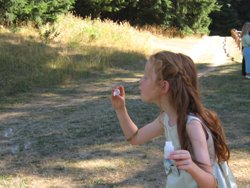
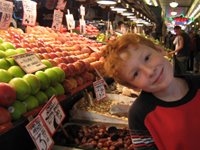
 Great news! In the last throes of packing for the big trip to my brother Josh's wedding on the other coast, my digital camera appeared--and of course it appeared in a place I was certain I had checked several times already. At any rate, there it was. Once lost, now found. I never was blind, but now you can see . . . our trip anyway.
I never have been too certain about what grace is, exactly. I know grace when I see it in movement, but people talk about God's grace, and I feel a little befuddled. But I think maybe I experienced some of it on this trip.
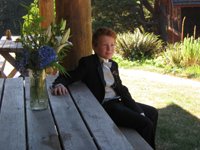
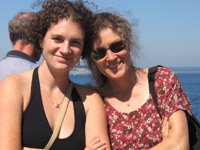
 All weddings are historic events in the lives of their main characters, but this one especially. I've told you already the story of Josh, my half-brother, how I met him a few years ago, and fell in love immediately. But the part I didn't really explain was that he has a whole 'nother family on the other coast--parents, brothers, the whole shebang. But never have the two sides come together. Until now. For a brief moment, in the length of time that it takes to say "cheese," there was tuxed-up Josh with all his siblings: his four sisters from the east coast, and his three brothers from the west. All of us. For the first and perhaps the onliest time. What a moment. Josh was clearly delighted, and not a little in awe.
But it might be that grace is sometimes experienced in darker moments as well. An unexpected wedding guest for me was an old, familiar surge of anger, one that I've not felt in quite some time. It came during the reception, after a series of toasts recounting various moments in Josh's life, including some references to his origins and my own dad. Even after all this time, all this work, all this "understanding" that I've been able to gain about my father by traveling through time, it turns out that I'm still mad. People start saying nice things about him, and I just want to get up and set them straight. It's an old, old knee-jerk response, and I wasn't happy to see that it's still in there.
But here's the grace in it (if grace is what you call it): I felt those old feelings, succumbed for a little bit, and then caught myself. "Oh," I said, "I see what's happening here. It's you, my old friend Mr. Anger. Nice of you to stop by, but the truth is, you're not really needed now. Things are fine here." We shook hands, and off he went. I breathed, and it was over. He was gone.

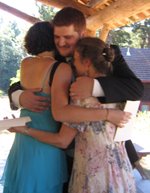
And so is Dad.
But the rest of us are still here, on this coast and that one, getting through our days, doing our best, raising our kids, still learning how to love.
I can't define grace in words, but I think I have a sense of it anyway.
And I'm glad to have my camera back.
Thursday, August 17, 2006
Loss
Have I lost it? It's a petite silver digital wonder. To me, at least. In actuality, it was the cheapest digital camera with the features I needed. But it does the trick. When it's not lost. I've been wracking my brain since the weekend, when I noticed it was missing. I wanted to pack it for our trip to the lake in Georgia, our second lake trip this summer, our last hurrah before beginning the school year. We went to the lake without it.
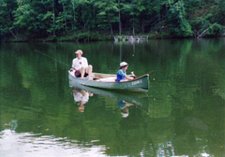 We had a glorious time anyway--full of cousins and grandparents and aunts and uncles and innertubes and games and watermelon and fish on the line. Everything the lake has always been, is supposed to be.
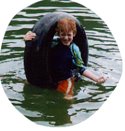
(These pictures are from our June trip, but they give you the idea.)
It wasn't all fun, though. There was childhood terror in the midst of a crashing thunderstorm. And tears all around the dock as we shared our memories of Aunt Martha, sent our songs soaring across the lake, and took turns letting handfuls of her ashes sift through our fingers into the deep, green water.
Though Mom came to the lake, she couldn't make it to the evening ceremony on the dock. Once she's had her supper, her lids begin the inevitable downward drift, and there's just no stopping the bedtime train.
Yesterday morning it was time to say goodbye. We skipped the age-old rituals of pre-departure picture-taking (my camera was missing, after all), but swept it all clean before waving our way down the winding gravel. Away.
Our family's car was full of children and dog, so Mom rode with my sister Nancy. When we got home, I called to make sure Mom had gotten home safely, but she was already out in the living room, getting reacquainted with her rest home neighbors. When she called back, she reported to my voice mail that they had gotten back about 3:30 and had a lovely time at the lake--swimming, boating, playing games. She couldn't wait to tell me all about it.
Couldn't wait to tell me all about it. She had already forgotten I was there. I was there.
I've decided not to get too bent out of shape about the camera. I'm guessing it'll turn up. Or, worst case scenario, I'll save my pennies and buy another. Cameras can be replaced.
Mamas, not so much.
 We had a glorious time anyway--full of cousins and grandparents and aunts and uncles and innertubes and games and watermelon and fish on the line. Everything the lake has always been, is supposed to be.
(These pictures are from our June trip, but they give you the idea.)
It wasn't all fun, though. There was childhood terror in the midst of a crashing thunderstorm. And tears all around the dock as we shared our memories of Aunt Martha, sent our songs soaring across the lake, and took turns letting handfuls of her ashes sift through our fingers into the deep, green water.
Though Mom came to the lake, she couldn't make it to the evening ceremony on the dock. Once she's had her supper, her lids begin the inevitable downward drift, and there's just no stopping the bedtime train.
Yesterday morning it was time to say goodbye. We skipped the age-old rituals of pre-departure picture-taking (my camera was missing, after all), but swept it all clean before waving our way down the winding gravel. Away.
Our family's car was full of children and dog, so Mom rode with my sister Nancy. When we got home, I called to make sure Mom had gotten home safely, but she was already out in the living room, getting reacquainted with her rest home neighbors. When she called back, she reported to my voice mail that they had gotten back about 3:30 and had a lovely time at the lake--swimming, boating, playing games. She couldn't wait to tell me all about it.
Couldn't wait to tell me all about it. She had already forgotten I was there. I was there.
I've decided not to get too bent out of shape about the camera. I'm guessing it'll turn up. Or, worst case scenario, I'll save my pennies and buy another. Cameras can be replaced.
Mamas, not so much.
Monday, July 31, 2006
Like a weed
My long and lean daughter must be heading into another growth spurt. She's been ravenous lately.
This time of year--getting on towards late summer, school starting in a couple of weeks--gets me thinking about growth. Weeds are beginning to win the battle in my garden. My more green-thumbed friends and family are starting to overflow with produce. The trees are as dark green as they'll get. Undergrowth is lush.
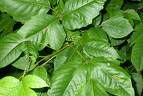
Plant growth is relatively gradual. I can watch my weeds go from pinch-sized to grab-it-and-yank, and it all seems pretty steady. But we humans seems to do it in fits and starts.
I think I've been going through a growth spurt myself lately, although fortunately it's been the visible-only-to-me variety. "Personal growth," as the self-help industry calls it, I suppose. I noticed myself noticing today, caught myself in the act of recognizing my typical reaction to an emotional event, giving that reaction a nod of greeting, and letting it pass on by.
I'm quite sure I won't be able to maintain this zen feeling indefinitely, but I'm appreciating it while it's here. And maybe, just maybe, it'll be a tiny bit easier to get to this place next time around.
Growth. Fits and spurts. And mighty cyclical. Being alive is a fascinating proposition. Especially when you can pay attention.
This time of year--getting on towards late summer, school starting in a couple of weeks--gets me thinking about growth. Weeds are beginning to win the battle in my garden. My more green-thumbed friends and family are starting to overflow with produce. The trees are as dark green as they'll get. Undergrowth is lush.

Plant growth is relatively gradual. I can watch my weeds go from pinch-sized to grab-it-and-yank, and it all seems pretty steady. But we humans seems to do it in fits and starts.
I think I've been going through a growth spurt myself lately, although fortunately it's been the visible-only-to-me variety. "Personal growth," as the self-help industry calls it, I suppose. I noticed myself noticing today, caught myself in the act of recognizing my typical reaction to an emotional event, giving that reaction a nod of greeting, and letting it pass on by.
I'm quite sure I won't be able to maintain this zen feeling indefinitely, but I'm appreciating it while it's here. And maybe, just maybe, it'll be a tiny bit easier to get to this place next time around.
Growth. Fits and spurts. And mighty cyclical. Being alive is a fascinating proposition. Especially when you can pay attention.
Wednesday, July 26, 2006
What's Left
Yesterday we moved Mom to the rest home. It felt more like an installation to me than anything else. So many people to move a small roomful of stuff, sisters cloaking feelings behind masks of efficiency. But the feelings sure leaked out around the edges. My own mask is a lot more transparent than it used to be. Supposedly that's healthy.
At one point I looked at my little stooped mama, never wavering in her decision, resolutely helping to carry way-too-big boxes. I said aloud, "she's so brave," and burst into tears. As I hurried across the porch to recompose my mask, I came to a windchime, hanging limply in the still morning air. No more chimes left--just the gonger in the middle, and wispy strings all around it. Nothing left to make music.
It's time.
At one point I looked at my little stooped mama, never wavering in her decision, resolutely helping to carry way-too-big boxes. I said aloud, "she's so brave," and burst into tears. As I hurried across the porch to recompose my mask, I came to a windchime, hanging limply in the still morning air. No more chimes left--just the gonger in the middle, and wispy strings all around it. Nothing left to make music.
It's time.
Subscribe to:
Posts (Atom)